MEDEM DATA NETWORK FOCUS: CONSORTIUM OF NATIONAL ELECTION STUDIES (CNES)
How can national election studies from different countries be connected to enable meaningful comparative research? The Consortium of National Election Studies (CNES) was created to address exactly this challenge. As part of the first MEDem Data Network introduction, a series highlighting key datasets and networks within MEDem, this post takes a closer look at CNES together with Olga Gyafarsova from Comenius University Bratislava, a member of the CNES Steering Committee.
1. How did it start? What was the original motivation behind launching the CNES?
At the beginning of every event, network, endeavor, project, collaboration … which emerges from below and not as a directive from any formalized structure, stands a group of enthusiasts who have the feeling that there is potential to do things better. That was exactly the starting point of the CNES – with inspiration, motivation and the assistance of FORS (which continues), an international community of electoral studies researchers came together and established the Consortium.
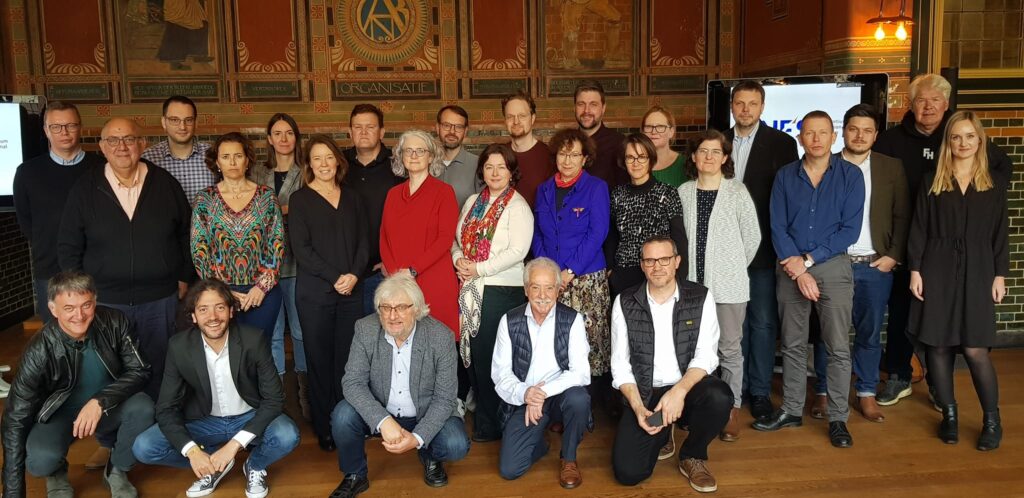
Someone – looking from outside – may have a feeling that the global research community is already over-networked, over-organized and there is no space for new ideas and activities. However, after more than three years of CNES’s existence, I am convinced that there was a gap that could be filled. I am personally honored to be a member of the “founding” Steering committee, which started to work in fall 2022 at an in-person meeting in Amsterdam.
Olga Gyarfasova
CNES Steering Committee Meeting in Amsterdam
2. What are your core objectives?
The core objectives are exchange of knowledge, standards and best practices related to election studies; providing research data through post harmonization of existing studies; conducting twice a year the CNES Seminar Series, which address challenges in designing and conducting election studies; simply – bringing together the national election study community and creating positive synergies across various countries.
3. How can researchers, policymakers, or journalists make use of CNES data in practice?
Very easily. I assume the most attractive resource is the CNES Knowledge Bank, which provides general information about national teams (currently 36 countries are included) and study contexts. The webpage offers the access to all the users may need – above all data and documentation as well as the research design. Additionally, CNES will soon release a comparative, post-harmonized data file, which should also become a very valuable resource for researchers doing comparative research on elections and voting behavior.
4. What characteristics from CNES data stand out to you the most?
Electoral research is a field where methods and challenges are constantly changing and evolving in response to the current environment and research needs. The set of designs, methods, and the palette of studies run by national election study teams is more diverse than ever before. To understand this diversity and to learn from other colleagues, to see the best (or better) practices, is for me huge comparative advantage of the CNES Knowledge Bank. In addition, the work of the CNES, incl. Knowledge Bank, is receiving input and feedback from a Scientific Advisory Board, which is composed of experienced researchers, and which helps us to move forward.
5. What benefits do you see in CNES collaborating with MEDem?
Elections are key in any liberal democracy. Recently, we have seen that in many countries liberal democracy is in decline, authoritarian tendencies are on rise, populist and extremists are more likely to win elections and govern, shortly – democracy is under pressure and democrats and researchers of democratic election must join all forces. Among other things, it is also important to study electoral behaviour, to monitor democracy, to establish high standards and best practices in these areas. MEDem and CNES have similar objectives, why not collaborate?
The MEDem team thanks Olga Gyarfasova for taking the time to share insights into the origins, objectives, and key features of the CNES network!
The European infrastructure for unlocking the true potential of data-driven democracy research