MEDem & GGP Hosted the CSDI Workshop 2026
From 23 to 25 March, the CSDI Workshop 2026 took place at the “Aula am Campus” of the University of Vienna, hosted by MEDem (Monitoring Electoral Democracy) and the GGP (Generations & Gender Programme). Bringing together researchers and practitioners in comparative survey design and implementation (CSDI), the workshop provided a forum for exchanging innovative methods and tools to advance comparative survey research across countries and disciplines.
Day 1 - Welcoming Speeches & Advancing Cross-National Survey Design
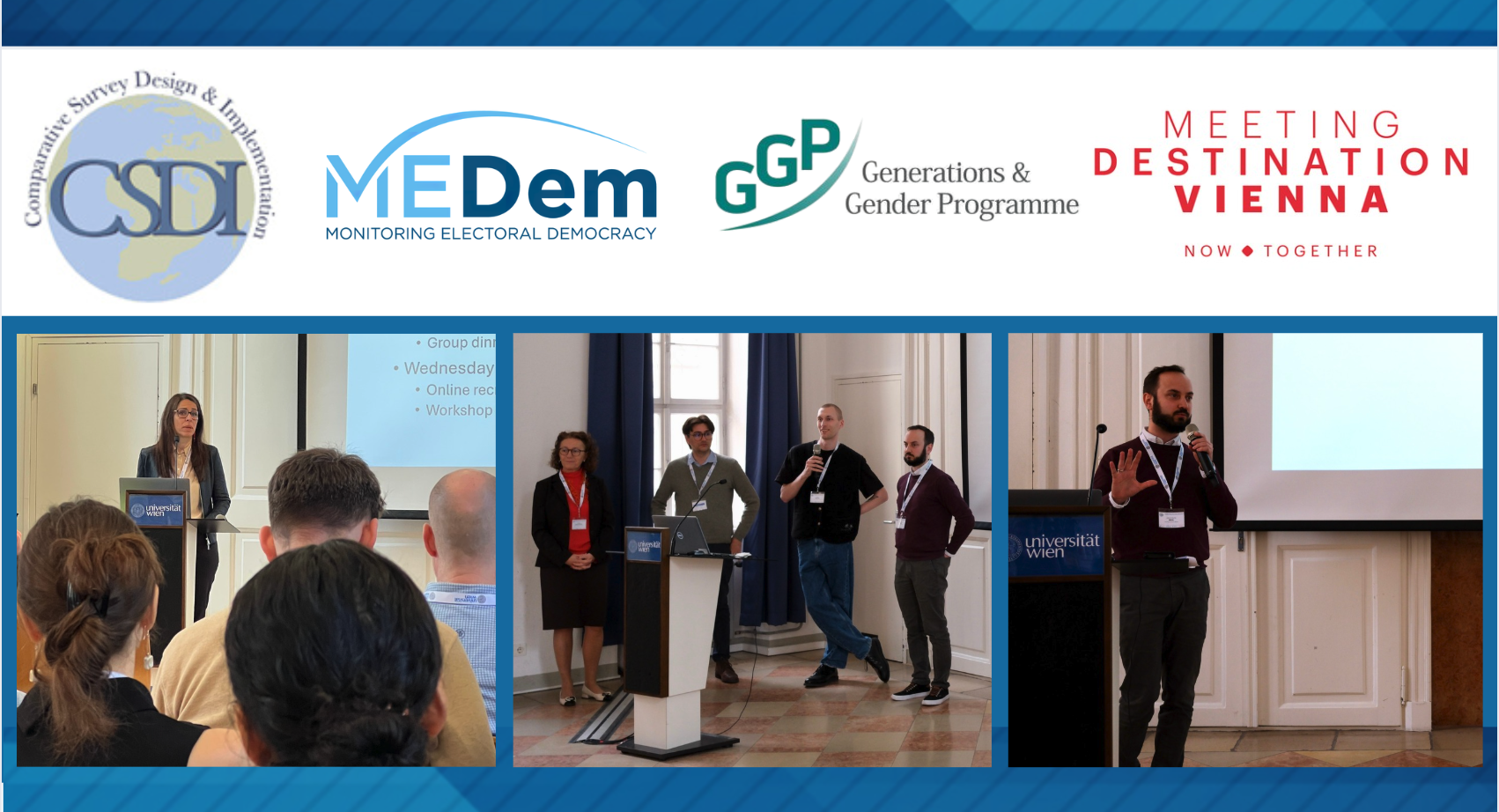
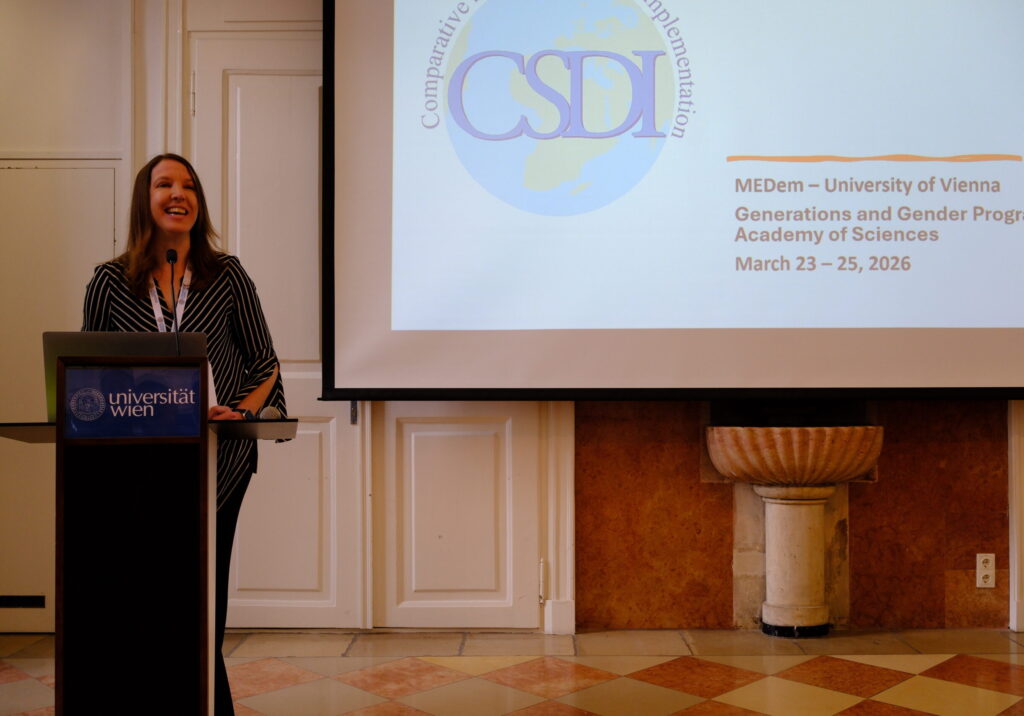
On the first day, Julie de Jong (Chair of the CSDI Executive Committee) opened the workshop by welcoming participants and organizers. In her remarks, she emphasized the importance of the conference as a space for connecting across the globe. Professor Sylvia Kritzinger (MEDem BoD) delivered a welcome address on behalf of the University of Vienna, highlighting the synergy among MEDem, GGP, and CSDI, particularly their shared commitment to high-quality, harmonized data to strengthen collaborative research structures.
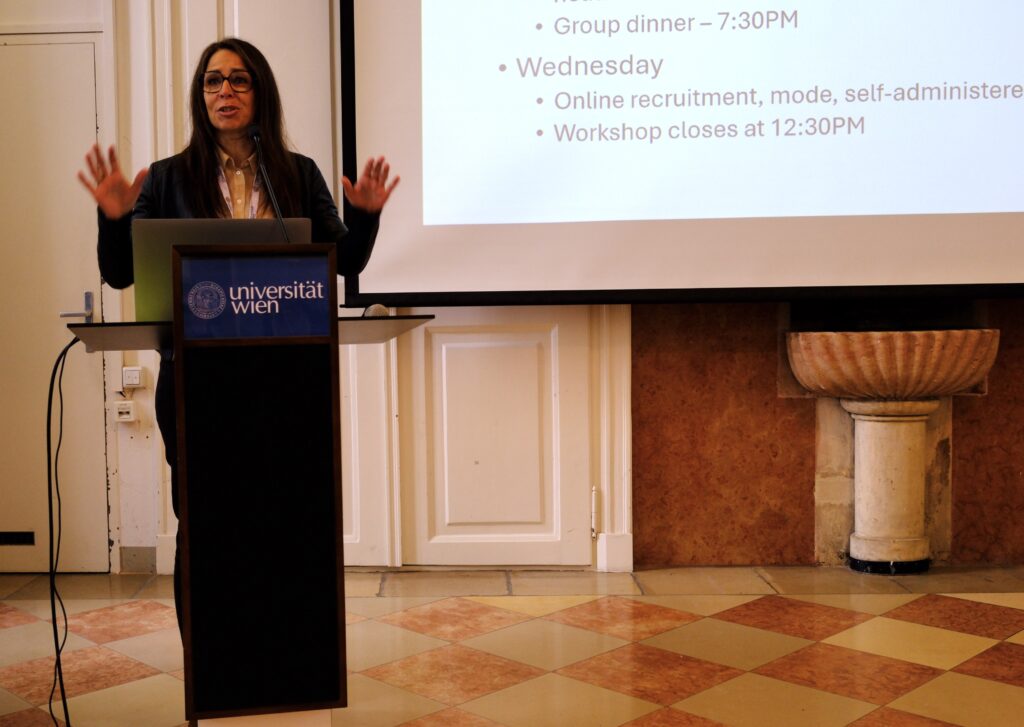
The first day featured sessions on advances in translation and questionnaire design, addressing key developments and challenges related to the application of computational methods in survey design and survey research. Discussions also explored representation across cultural contexts, as well as research support services. The day concluded with a business meeting in which participants discussed recent advancements, partnerships, and future directions in the field.
Day 2 - Data Quality & Creating Sustainable Research Infrastructures
The second day focused on advancing data quality and comparability in cross-national research. A central highlight of the day was the panel on “Visions for the Future: Creating Sustainable Research Infrastructures”.
- Jakob-Moritz Eberl (MEDem Headquarters) presented MEDem’s approach to enabling data linkage and harmonization in democracy research, emphasizing its role in building an open and collaborative research infrastructure.
- Paul Bederke (MEDem SC for Data Linkage) then introduced PolPaL, a core MEDem Service Tool that enables the linkage of political party data across datasets and time, addressing a central challenge in comparative political research.
- Isabella Buber-Ennser (Austrian Academy of Sciences, Vienna Institute of Demography) & Yuri Pettinicchi (GGP – NIDI) presented the Generations and Gender Programme, showcasing its data dissemination tools and strategies that support cross-national research.
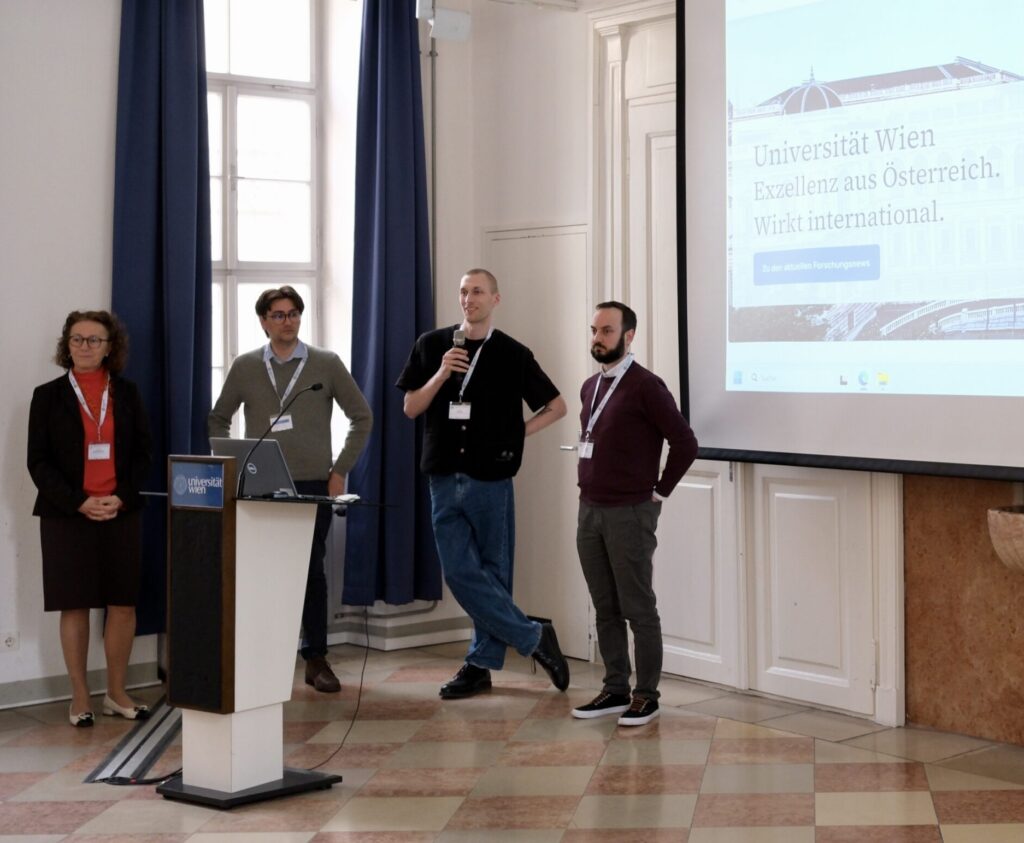
Moreover, presentations on the second day addressed international standards in survey research, new approaches to quality control using ASR and LLMs, ODISSEI’s work on automating the record linkage lifecycle, methodological challenges in demographic surveys, and research designs for evaluating childhood vaccination coverage across diverse settings.
Day 3 - Innovations in Survey Recruitment
The final half-day highlighted innovations in online and self-completion surveys across different national contexts, such as Japan, Albania, Malta, and Iceland. The sessions addressed panel retention, response burden, recruitment strategies, mode effects and equivalence testing, as well as the European Social Survey’s mixed-mode transition.
Overall, the workshop brought together presenters from a wide range of universities and research institutes, including Share Berlin Institute, cApStAn, Verian Group, GESIS – Leibniz Institute for the Social Sciences, the U.S. Census Bureau, University of London, Centre for Lifelong Learning, Utrecht University, German Institute for Adult Education, IPSOS, Verian Group, Norstat, Mannheim University, DIW Berlin, University of Chicago, European Social Survey, University of Tokyo, University of Michigan, Masaryk University, ODISSEI, University of Vienna, University College London, Austrian Academy of Sciences, University College Dublin, among others.
Notably, many of the presenters were colleagues from MEDem partner infrastructures or research institutes that have signed a support letter for MEDem.
More About the CSDI
The International Workshop on Comparative Survey Design and Implementation (CSDI) was founded in 2002 in Brussels during a meeting of researchers specializing in cross-national and cross-cultural studies. Since then, it has served as an important forum for advancing comparative survey methodology. Held annually, the workshop brings together researchers from around the world to strengthen the field and foster collaboration on key methodological challenges.
A core principle of the workshop is the integration of multinational, multiregional, and multicultural perspectives, known as 3MC, within the survey research community. It promotes methodological innovation, encourages the adoption of best practices, and supports the development of tools and standards that ensure the comparability of survey data across diverse populations and contexts. The 3MC approach also contributes to the production of essential cross-national statistics on education, labor, public opinion, health, and well-being, playing a key role in tracking progress toward global benchmarks such as the United Nations Sustainable Development Goals (SDGs).
This year’s workshop aimed to strengthen international networks among researchers and institutions involved in comparative survey research and to share state-of-the-art methods and tools for 3MC survey design and implementation. Additional objectives included promoting harmonization strategies to reduce comparison error and improve data quality, as well as fostering cross-sector collaboration to enhance the use of comparative survey data for policy and practice.
More information can also be found on the CSDI Webpage.
With Thanks to all Participants & the Vienna Meeting Fund
The organizing team extends its appreciation to all visitors, researchers, organizers, and participants. It was a pleasure to host this year’s workshop and to contribute to such a dynamic and collaborative event.
A huge thank you to the Vienna Convention Bureau for supporting CSDI 2026!
The Vienna Convention Bureau offers extensive information on our host city and has provided CSDI with support from their Vienna Meeting Fund.
Check out their website here: Meeting Destination Vienna
And download the Vienna City Guide here: Vienna City Guide