MEDEM DATA NETWORK FOCUS: THE MANIFESTO PROJECT
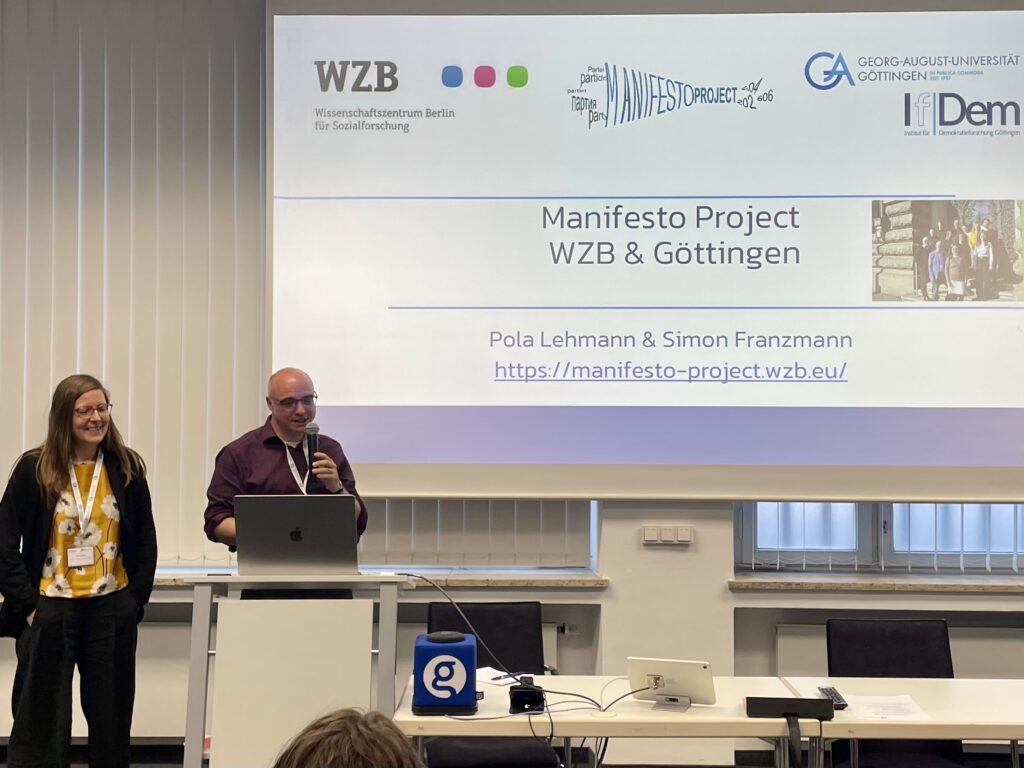
What can election manifestos tell us about party competition across democracies? For decades, the Manifesto Project has provided a systematic way to trace party positions, issue salience, and programmatic change across countries and over time. As part of the MEDem Data Network introduction series, Pola Lehmann (WZB) and Simon Franzmann (University of Göttingen) reflect on the project and its role within the wider democracy research infrastructure landscape.
1. What was the original motivation behind the Manifesto Project?
The Manifesto Project was founded in 1979 at an ECPR General Conference out of the desire to create a measure to estimate and compare party competition between countries and over time. Key questions at the time were: How do parties position themselves in relation to each other? How do they react to position changes of competing parties, and to electoral gains and losses? What differences do we see between varying electoral systems?
The founding members chose election programmes as their source for two main reasons. First, these are documents that are available in almost all countries of interest and are published within a similar timeframe (i.e. shortly before an election). Second, choosing text analysis allowed to extend the analysis into the past, which would not have been possible to the same extent with mass and expert surveys.
2. How can researchers, policymakers, or journalists make use of the Manifesto Project's data in practice?
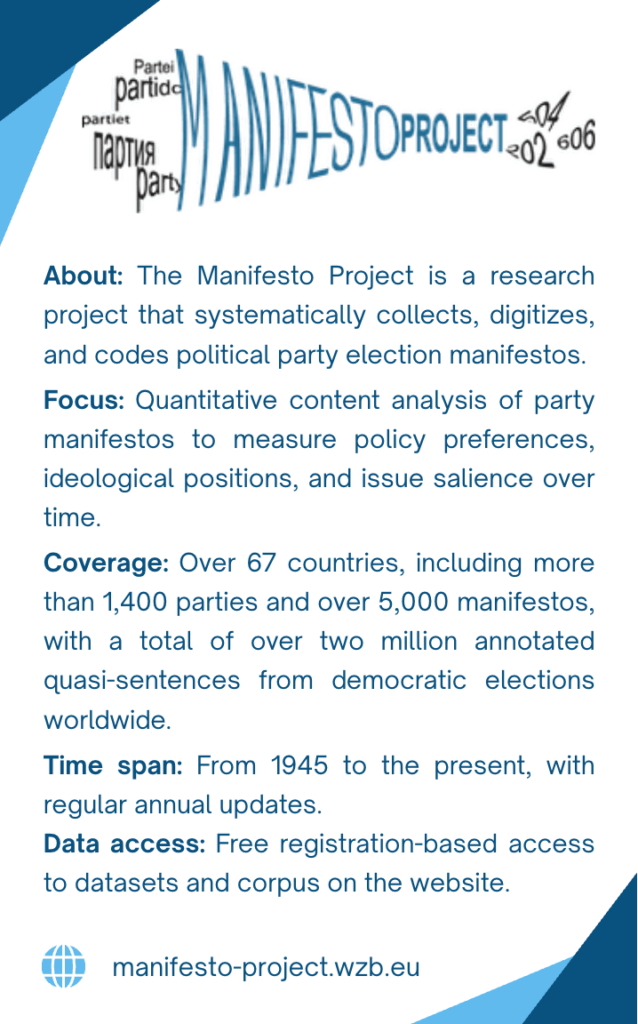
The Manifesto Project Dataset and the Manifesto Corpus, along with lots of accompanying material such as our Coding Handbook and a dataset on the political parties covered by our data, are available to download for free on our website. Downloading the data just requires a quick registration. To make the data easily accessible to a variety of users, we provide visualisation tools and tutorials, offer the R-package manifestoR to facilitate access to and analysis of both the dataset and the corpus, and provide an API. Finally, we also offer our own fine-tuned LLM manifestoberta for automated text classification.
Given the variety of data and tools available, the possibilities to work with the Manifesto data are manifold. You can use the data to track changes in positions or issue salience, estimate party positions, generate your OWN policy indicators, compare parties from the same party family across countries, analyse representation, conduct qualitative analysis of manifesto texts, analyse the readability or group appeal in manifestos, classify speeches or press releases according to our category scheme, and so much more.
3. What characteristics from the Manifesto Project's data stand out to you the most?
What stands out most from the Manifesto Project’s data are:
- Its contribution to the analysis of party competition.
- Its long-term and broad country coverage, allowing for comparison of a variety of cases, which make it a very unique data source.
- Its large, annotated text corpus (over 2 million annotated quasi-sentences).
- Its flexibility of usage.
We offer many different outputs from the data production process, including original documents, machine-readable manifestos, annotated texts, content-analytical data, and contextual information on countries, elections, parties, and party families.
This gives users the flexibility to tailor the data to different research needs and to create their own measures, indicators, and innovative analytical approaches.
4. What benefits do you see in the Manifesto Project being part of MEDem?
MEDem offers a great platform to collaboratively find better ways to integrate different data sources. It provides a strong voice for existing data infrastructures to increase awareness among other researchers, and politicians about the needs of such infrastructures and what they have to offer if equipped with the right infrastructure.
The MEDem team sincerely thanks Pola Lehmann and Simon Franzmann for taking the time to share insights into the origins and key features of the Manifesto Project!