PolPaL: Connecting Political Party Data Across Datasets and Time
Political Party Links (PolPaL) is now live. As part of MEDem’s Services, this new linkage key database helps researchers match political parties across datasets, even when parties change names, split, merge, or run as part of an electoral alliance.
A new database for linking political party data
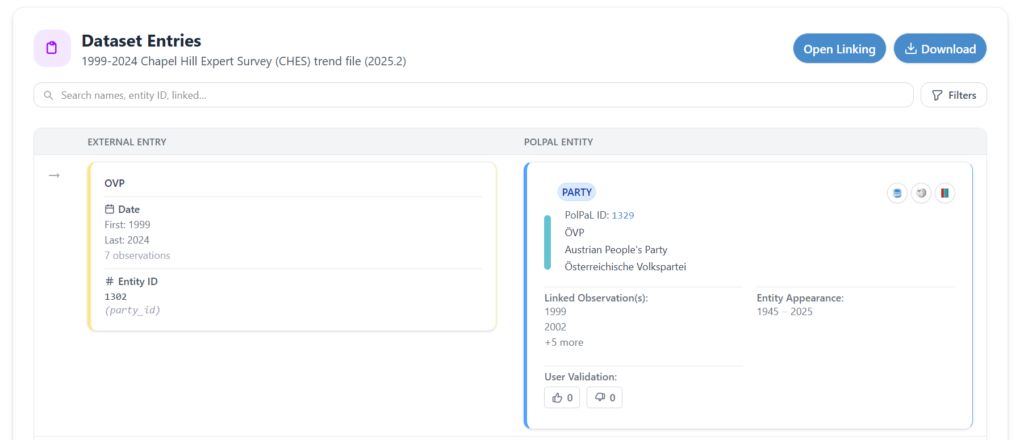
Political Party Links (PolPaL) is an online platform that supports researchers in identifying political parties across social science datasets. An election results dataset might record votes for an alliance, while a dataset on party positions lists the alliance’s members separately. To connect the two, researchers need to know which parties belonged to the alliance at the time of the election.
Inspired by Party Facts, PolPaL provides linkage keys for identifying political parties across datasets, even when sources use different names or identifiers. It also records splits and mergers and tracks membership in electoral alliances, parliamentary factions, and other groupings. Its links are time-sensitive, so researchers can see when a relationship applies and use that information when combining data.
Help build PolPaL
If you work with political party data, we’d love for you to try PolPaL and share your feedback. You can register to review and validate existing links or open a ticket if you spot an error or have an idea for an improvement. You can also add new datasets and create links directly on the platform.
PolPaL is designed as a community project, and we would love to hear how it works for your research and what would make it more useful to you.
Time to say thank you
The MEDem Service Center for Data Linkage at GESIS developed PolPaL over 22 months. We thank the OSCARS project for funding the work and the researchers who shared feedback throughout development, especially those who came to Cologne to test an early version. A special thank you to Sarah Bachmeier, Jakob Mansius, Kyra Meyer, Selcuk Timur Uluer, and Amelie Veit for testing the platform and generating data.